Saturday, February 22, 2014

My MIND MAP on PROF. DOUGLAS MONTGOMERY's Lecture on "INNOVATION, QUALITY TECHNOLOGY & STATISTICS" at ISE Dept, Faculty of Engrg, NUS on Friday, 21 Feb 2014

MIND MAP SUMMARY of LECTURE BY PROF. DOUGLAS MONTGOMERY on 21 Feb 2014
NETWORKING EVENT Organised by ISE Department, Faculty of Engineering, National University of Singapore
I was glad to attend the excellent presentation by Professor Douglas Montgomery on "Innovation, Quality Technology & Statistics".
It was an evening where the Professor shared his thoughts that Industrial Engineers (IE) should be renamed/called as Innovation Engineers instead. Lots of questions/ anecdotes were shared......among them were:

1) Prof. Douglas Montgomery's "Ask my driver" anecdote. He also mentioned that executives and managers nowadays, are not EXCITED about quality but are more EXCITED about new products instead.
2) The difference between an Engineer and a Doctor..... wrt the goals of "Landing a man on the Moon" and "Finding a cure for cancer" by Prof. LC Tang
3) Sharing of how to deploy 6sigma methodology in education? 
4) Comparing ISO companies to those who really cared about Quality .....--> being ISO does not mean or lead to Quality products.....it just means following a set of procedures! to........
5) Using DOX in determining teacher effectiveness.....!
6) Executives not quite interested in QUALITY. They get extremely EXCITED only in NEW PRODUCTS.
7) Quote: "All experiments are DESIGNED EXPERIMENTS"
8) Difference between an Aerodynamics expert (Theorist: Dr Samuel P Langley) versus two Bicycle Mechanics (Experimenters: Wilber and Orville Wright) is the former built 2 planes that failed to take off, while the later built planes that eventually flew!
9) Research is to create SURPRISES and take RISKS... while, Development must not have SURPRISES and ZERO RISKS! Hahaha.

It was an enjoyable evening and am looking forward for the next talk. 

Thank you for viewing.

Mind Map Blog by Choon Boo LIM is licensed under a Creative Commons Attribution-NonCommercial-NoDerivs 3.0 Unported License

Thursday, February 20, 2014

My ACTA MIND MAPS of Various COMPETENCY UNITS (CU) and COMPETENCY ELEMENTS (CE)


COMPETENCY UNIT 3A - CE1: DEFINE PARAMETERS OF THE TRAINING PROGRAMME


COMPETENCY UNIT 3A - CE2: DESIGN THE TRAINING PROGRAMME

COMPETENCY UNIT 3A - CE3: DEVELOP THE TRAINING PROGRAMME
COMPETENCY UNIT 3A - CE4: EVALUATE THE TRAINING PROGRAMME

COMPETENCY UNIT 5 - FORMAT for an ASSESSMENT PLAN
Several relevant mind maps of Competency Elements (CE), Competency Units (CU) as well as others are posted here. These were drawn during the period that I was enrolled in the  "Advanced Certificate in Training and Assessment (ACTA)" course. These mind maps should preferably be used as an aid together with the full set of WSQ ACTA documents that is normally provided to each course participant.

My goal is just to share with like-minded visual learners of the mind mapped knowledge/notes that I drew by hand or created on the very useful Mindmanager software. Hope it helps. Enjoy.

Thank you for viewing.

AFTERNOTE:
Just to share with viewers that I successfully completed my WSQ course in "Advanced Certificate in Training and Assessment (Facilitated Learning)". Thank you Oei Min. It was a wonderful experience going through the ACTA course. I shall treasure it. A skill-based qualification is definitely important in our Polytechnic & ITE educational system. In my opinion, more emphasis and focus should be given in this area as it will definitely make people proud of their acquired skills. 

Mind Map Blog by Choon Boo LIM is licensed under a Creative Commons Attribution-NonCommercial-NoDerivs 3.0 Unported License

Wednesday, February 19, 2014

My MIND MAP of NOTES of a MEETING Recorded in REAL-TIME

NOTES OF MEETING THAT WAS RECORDED IN REAL-TIME on an A5-sized Paper


This is an example of how we could re-decorate a mind map that we recorded using a single colour pen and make it appealing to the eye and ..... of course, the brain.

I did not bring my usual set of colour pens to the meeting and hence still decided to take down notes in my normal mind map format using my only blue ball-point pen.

Subsequently, I just used my favourite Staedtler(TM) brand colour markers to underline the branches with different colour at my own time, after the meeting. I was quite pleased with the clarity and compactness that the mind map has summarised the notes of the meeting for me.

Noticed that it is not possible to mind map the notes to this level of compactness and speed using any computerised mind map software, like mindmanager, iMindmap and others available today. Can you think of any reasons why this is so? Haha.

I have always emphasized that the best way of developing one's mastery in mind mapping notes of meeting in real-time is to do it by hand and in-situ. Hope you understand the reasons for my recommendation.

Thank you for viewing and enjoy.

Mind Map Blog by Choon Boo LIM is licensed under a Creative Commons Attribution-NonCommercial-NoDerivs 3.0 Unported License

Monday, February 17, 2014

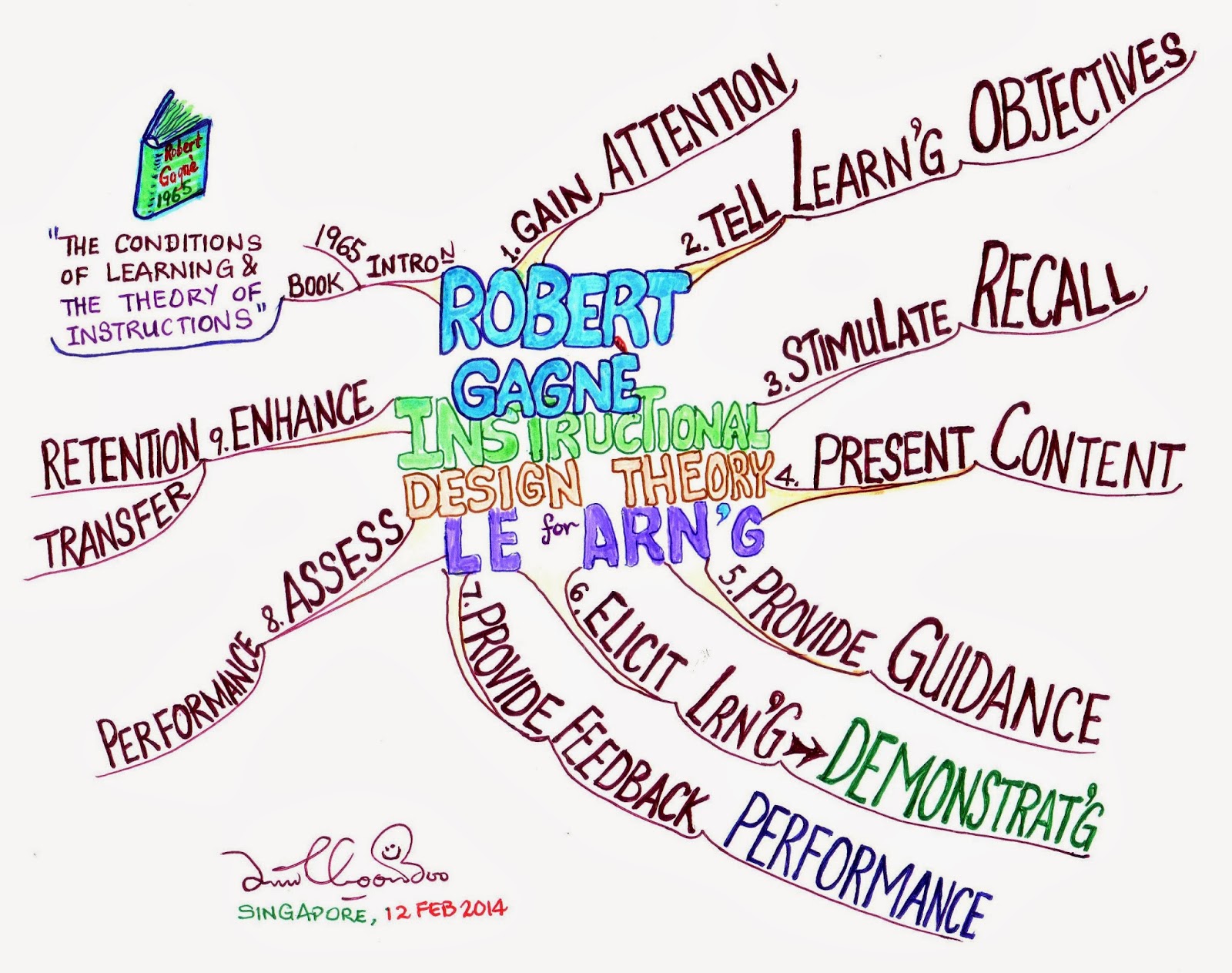
My MIND MAP of ROBERT GAGNE's INSTRUCTIONAL DESIGN THEORY for LEARNING

ROBERT GAGNE's NINE INSTRUCTIONAL EVENTS FOR LEARNING TO HAPPEN
I first came across Robert Gagne's nine events of instructions for learning soon after attending the WSQ's "Advanced Certificate for Testing and Assessment" (ACTA) course. The ACTA course was conducted by Ms Oei Min, a very experienced WSQ instructor and facilitator of learning.

I find Gagne's nine instructional events theory an interesting supplement/guide in teaching my students. After many years of teaching students to learn and how to learn, I have learnt that by adding the element of FUN as much as possible to every one of the nine steps, one can enhance learning and retention. Please enjoy the mind map.

Mind Map Blog by Choon Boo LIM is licensed under a Creative Commons Attribution-NonCommercial-NoDerivs 3.0 Unported License

Saturday, February 15, 2014

My MIND MAP of Prof. MOSHE F. RUBINSTEIN's Lecture on "MINDING ORGn - BRINGING the FUTURE to the PRESENT"

Prof Moshe F. Rubinstein on "MINDING ORGANISATION - BRINGING the FUTURE to the PRESENT"
This real-time mind map of the above mentioned seminar organised by the Ministry of Manpower (MOM) Academy on 9 Jan 2001 never fails to amaze me on how I managed to capture the essence of Prof Moshe F. Rubinstein's talk.

I could still remember January 2001 as the month where I did a record number of beautiful mind maps. The above lecture by Professor Moshe F. Rubinstein was indeed memorable in that it taught me always to try to picture the future and bring it to the present. By doing so, your project would always most likely succeed.

Prof Rubinstein gave lots on examples on this concept......like how Imhostep, the great Egyptian pyramid builder took 20 long years to build the pyramid. Imhostep definitely was able to "see" the future (i.e. plan into the future) and bring the plans back to the present. Like he was able to cater for all the barriers and obstacles that may hinder the success of his project.

One of the questions that I always asked my students and participants is, how did the Egyptians managed to place the last stone (weighing one ton), on top of the 460 feet high pyramid, 4000 years ago? What equipment did they use at that time? How did they manage to build an almost perfect pyramid? What type of measuring instruments were used during the building stage?.....etc...

It was really a challenge for me to mind map the talk on just one sheet of A3-sized paper, considering the fact that there was no table for me to place my mind map on. All I had was, a flat plastic document container that I had to place on my leg/thighs to form a temporary table. I had to switched my legs several times during the 2-hour seminar so as to keep the blood flowing, if you know what I mean. On top of that I had to hold a bunch of colour pens that I had to switch quickly to reflect the tone of the speech and etc....Haha.

Of course, the reward for me was admiring the fact that I managed to capture much of Prof. Rubinstein's brilliant lecture on "Minding Organisation - Bringing the Future to the Present" all packed onto just one sheet of A3-sized paper. Professor Rubinstein and Dr Tan Chin Nam, the then PS of MOM graciously autographed the mind map on the spot.

Not many people in the world have the ability to really think about the future and bring it back to the present. Among those who can, I think, were Imhotep, the great Egyptian pyramid builder, Qin Shi Huang, the first emperor who unified China and many others. Have you encountered anyone like them in modern times? Haha.

I have my own list and I am sure you have a similar list too. Do enjoy the mind map and continue formulating your list. More importantly, do what Professor Rubinstein advocates, that is, to bring the Future back to the Present. This really calls for imagination on a cosmic scale. Thank you for viewing.


Mind Map Blog by Choon Boo LIM is licensed under a Creative Commons Attribution-NonCommercial-NoDerivs 3.0 Unported License

Friday, February 14, 2014

My Mind Map of a SECONDARY 1 or 2 GEOGRAPHY SUBJECT - PHYSICAL and HUMAN LANDSCAPES

GEOGRAPHY - PHYSICAL AND HUMAN LANDSCAPES

When I was young, I always wanted to remember as much as possible of what I have read, learned or listened in classes, lectures, seminars, etc. Do you have that love for knowledge, memory and recall too? If you do, then, I think you would probably come to love the mind mapping technique as it is perhaps one of the best information crunching / retention / memory tool available! Haha.

So after learning the rudiments of mind mapping from Tony Buzan, Vanda North, Mun Sang and others, I quickly went on to mind map almost anything....... that I would like to remember/recall.

As I browsed through the numerous mind maps that I have done over the years, I tumbled across the above mind map that I did for my nephew in 2001. Hope it amazes you as much as it amazes me on how much information is packed onto just one sheet of A4-sized paper. Enjoy.


Mind Map Blog by Choon Boo LIM is licensed under a Creative Commons Attribution-NonCommercial-NoDerivs 3.0 Unported License

Monday, February 03, 2014

REVISION MIND MAPS for COMPOSITE MATERIALS Chap 5 and 6

CHAPTER 5 - COMPOSITE REPAIR


CHAPTER 6 - QUALITY CONTROL

Today was quite interesting and exciting as I managed to make a Mind Map summary of Chapter 5 (Composite Repair) and Chapter 6 (Quality Control) respectively for my students.


Mind Map Blog by Choon Boo LIM is licensed under a Creative Commons Attribution-NonCommercial-NoDerivs 3.0 Unported License
Wednesday, December 04, 2013

REVISION MIND MAP on CHAPTER 1 - INTRO to COMPOSITES

 
MM of CHAP1 in Real-time during Class T1A2 tutorial


Hopes it helps in revision. Notice that there is a branch that links it to Chapter 2 - Conception and Design of Composites. The reason for this extra branch is due to active participation of the students during the discussion. It led me to link it to relevant portions of Chapter 2.

I did various sizes of mind maps depending on the size of the whiteboard. Attached below is a panoramic view of both Chapter 1 and 3 and separately. These image were contributed by my student, Christopher Koh.
Panoramic View of Chapter 1 and 3


The individual mind maps of Chapter 1 and 3 are attached below for better viewing.

Chapter 1 on Introduction to Composites

Chapter 3 on Manufacturing Processes


Mind Map Blog by Choon Boo LIM is licensed under a Creative Commons Attribution-NonCommercial-NoDerivs 3.0 Unported License

REVISION MIND MAP on CHAPTER 3 - MFRG PROCESS of COMPOSITES


MM of CHAP3 in Real-time


Hopes it helps in your revision.

I did another mind map on Chapter 3. Here it is:
Chapter 3 on Manufacturing Processes


Mind Map Blog by Choon Boo LIM is licensed under a Creative Commons Attribution-NonCommercial-NoDerivs 3.0 Unported License

Monday, November 18, 2013

REVISION on CHAPTER 2 - CONCEPTION & DESIGN OF COMPOSITES


MM for T1N4 class on 20 Nov 2013
Another mind map on the same topic. But this time one may notice that the amount of information is even more than the earlier two. 
The reason for this could be because this class has more questions to ask. The mind map actually encourages the students to open up and ask for clarifications on some of the branches. Thus, as any real-time mind mapper would do, I added the clarifications to the appropriate branches!
WOW! I could only do this with a mind map and yet maintain the clarity that is typical of this wonderful technique.


MM for T1A2 class on 19 Nov 2013
Above mind map on the same topic was drawn within half-an-hour for class T1A2. Notice, this mind map has slightly more details than the earlier mind map that I drew for T1N2 on 18 Nov 2013.
I think it makes a good and effective summary for the students as I completed it in real-time and interactively with the students.
SUMMARY OF CHAPTER 2-CONCEPTION & DESIGN OF COMPOSITES


As usual, I drew a quick mind map of the conception and
design of composite materials for my students. It is a summary of Chapter 2 of the Composite Materials module which is part of the 1st year curriculum of the Diploma in Mechanical Engineering course.

From past experience, many whole-brain- learners/students find it useful for revision as it provides a quick overview of the whole chapter. Just sharing.

Mind Map Blog by Choon Boo LIM is licensed under a Creative Commons Attribution-NonCommercial-NoDerivs 3.0 Unported License

Sunday, November 10, 2013

MIND MAP on a PROCESS IMPROVEMENT TECHNIQUE


Hello again. 
The Process Improvement Technique mind map is intentionally drawn with some branches having more than one word.

Ideally, I could have drawn the above Process Improvement Technique mind map using only one-word per branch, but could anyone understand it as much as what I would like them to? Thus, the true mind map has one difficulty in explaining its message in full, especially without the originator's explanation.

The above summary of a Process Improvement Technique mind map is meant as a guide for those interested to use it for their Quality Control Circle (QCC) projects. 

Have fun.

Mind Map Blog by Choon Boo LIM is licensed under a Creative Commons Attribution-NonCommercial-NoDerivs 3.0 Unported License

Monday, July 29, 2013

REVISION MIND MAPS for Topics on Copper, Aluminium and Polymer

Mind Map for Class LA34
I did two other similar Mind Maps for different classes today. However, they are slightly different from each other as it depends on the questions asked by the students in each class as shown.
Mind Map for LM56

Mind Map for LMK7

Some of the students find the mind maps useful for their revision, while others find that it looks quite untidy and disorganised.

As in all learning aids, it is not easy to find a learning technique that meets the requirements of all learners. Thus, fortunately, for those who are "Linear thinkers" and find it untidy, I have the powerpoint notes that they could refer to.

For those who could see the potential of the Mind Map summary or overview that I have drawn for them, could go further by adding on more branches or facts onto the above mind maps that I have drawn. Good Luck. 

I have just updated my post to include another real-time Map that I did just a few hours ago.

Mind Map for LN12


.

Mind Map Blog by Choon Boo LIM is licensed under a Creative Commons Attribution-NonCommercial-NoDerivs 3.0 Unported License

Tuesday, June 04, 2013

Using iMindMap to Present Yourself

I attended the world's first iMindMap Certification course conducted by Mr Chris Griffiths, the CEO of ThinkBuzan. It is the world's only Mind Mapping software that is officially endorsed by Tony Buzan, the Inventor of Mind Maps.

The above powerpoint slide was easily created by the iMindMap software. The application is quite user friendly and I would recommend it to anyone who likes the beauty of the organic branches and also in the manner in which you can do presentation in a natural, brain-friendly way.

For viewers with Apple's iPads or Andriods, a tablet version is downloadable from the internet. It is useful to have one on your iPad rather than your mobile phone, as with a bigger screen you would be able to have a good overview of your mind map.

My CV could easily be read from the above iMindMap. Enjoy.

Mind Map Blog by Choon Boo LIM is licensed under a Creative Commons Attribution-NonCommercial-NoDerivs 3.0 Unported License

Friday, May 31, 2013

Summary of Chap 2, 3 & 4 - Quick Review / Revision of Lessons Using Charts and Mind Maps

Summary of Chap 2, 3 & 4 - An Overview

This real-time mind map summary was done for my students as part of a quick review / revision for Chapters 2, 3 and 4. It provides them with a quick guide as to the KEY points covered during lectures. 

However, students have to read up the powerpoint lecture notes if they do not understand or forgot what the key words used in the mind map meant. Enjoy.

Mind Map Blog by Choon Boo LIM is licensed under a Creative Commons Attribution-NonCommercial-NoDerivs 3.0 Unported License

Chap4 - Quick Review / Revision of Lessons Using Charts and Mind Maps

Chap 4 - Heat Treatment Processes


This is not a mind map. It is just a summary that I did to show how the Phase Diagram used in Chap 3 is used to show where the Heat Treatment processes [ Hardening, Full Annealing, Spheriodisation, Process Annealing ( Stress Relief Process) Normalising ] are in relationship to the Upper Critical Temperature and Lower Critical Temperature.

Students going through this Chap 4 were also shown how the traditional Katana Samurai sword was made. The hardening process involving the heating to its austenitising temperature, is followed by the quenching process as well as the tempering process.

The range of the tempering chart is shown together along side with parameters such as %elongation, %Area reduction, Yield Strength, Ultimate Tensile Strength and Impact value. To be a Master in making the sword obviously involves intimate knowledge of the heating, cooling and tempering process as well as the material that goes to make the sword.

Well, what do you think is the %carbon content in a Katana Samurai Sword?

Mind Map Blog by Choon Boo LIM is licensed under a Creative Commons Attribution-NonCommercial-NoDerivs 3.0 Unported License

Chap3 - Quick Review / Revision of Lessons Using Charts and Mind Maps

Chap3 - Plain Carbon Steel - Phases & Mechanical Properties


Mind Map Blog by Choon Boo LIM is licensed under a Creative Commons Attribution-NonCommercial-NoDerivs 3.0 Unported License

Chap 2 - Quick Review / Revision of Lessons Using Charts and Mind Maps

Chap 2: Properties and Different Types of Mechanical Tests


This quick review of Chap 2 mind map would provide a summary of the various topics covered, namely, properties ( Physical and Mechanical ) plus some of the main types of mechanical tests ( Tensile, Hardness, Impact,  Creep and Fatigue ).

Students need to dutifully read through their lecture notes and then associate what they have read with the key words found in the mind map above. Only then, would the above mind map be extremely useful. I just could not imagine a world without mind maps. Please enjoy.

Mind Map Blog by Choon Boo LIM is licensed under a Creative Commons Attribution-NonCommercial-NoDerivs 3.0 Unported License

Friday, May 24, 2013

GIGO versus GIGG

I was reading Edward de Bono's "New Thinking for the New Millennium" when I came across an expression GIGO (Garbage In, Garbage Out) commonly used term in the computer world. Dr Edward de Bono stated that this computer logic "is the same with human logic. If the starting perceptions are faulty or inadequate, then flawless logic will produce absurd answers. But, much more dangerously, we will believe those answers to be valid."

The GIGO expression reminded me of Tony Buzan's book "Head First". He wrote that the computer GIGO logic that was thought to be true as to how the human brain thinks for many years, was in fact NOT TRUE. He emphasised that the human brain thinks, (in a more graphical way) as GIGG - i.e. Garbage In, Garbage Grows! 

He wrote that, "armed with this new information we can reconsider the idea that our synergetic brain is self-creative" as well as the fact with "the GIGG equation, the human brain can also be synergetically destroyed when rubbish or pollution infiltrates its incredibly sophisticated and complex systems....." eventually leading to "instances of suicides, murders, wars," and acts of unexplained shootings and killings in many parts of the world. How do we prevent this from happening? Apparantly, we need all to understand how the BRAIN really functions!

From my many observations, I have seen that a lack of understanding of this knowledge about the BRAIN has led to many individuals/groups "being led" to the path of "no return". Likewise, individuals/governments/countries with knowledge of how the brain functions may be able to save or pull some of these individuals to the "right path", from being depressed, individual/mass suicidal packs, or committing many unexplainable acts that we see today.

However, it is easier said than done. In the first place, the troubled individual / group needs to voice out their concerns. Sometime they communicate, but, no one seem to listen to them. Most of the times they may choose to remain silent and then, exercise their dissatisfaction through some non-violent acts like the ballot box, street demonstrations, etc... So....How could to we solve this BRAIN problem? Haha. How do we win the TRUST of these troubled individuals/group in order to win or turn them over? It is not easy......! I believe, lots of hard work is needed, sincerity in helping and giving would certainly be one of the ways.

Thus, to summarise this post in very simple terms, I would look at GIGO as how computer logic works and GIGG as how the synergetic human brain thinks. It is important to recognise this Brain Principle of Synergy. The reader may wish to explore other Brain Principles in Tony's book "Head First". Alternatively, the reader is also invited to view the various Brain Principles in a Mind Map that I did during Tony's two-day workshop in Singapore [ CLICK HERE ]
and
an excellent TEDx presentation on "The Power of a Mind to Map" that he gave in Dec 2012 [ CLICK HERE ]!

Enjoy! Thanks.

Mind Map Blog by Choon Boo LIM is licensed under a Creative Commons Attribution-NonCommercial-NoDerivs 3.0 Unported License

Sunday, May 12, 2013

Chinese Tsunami vs Malaysian Tsunami

The Malaysian General Election (5 May 2013) ended with the Barisan Nasional (BN) forming the next government. What is interesting are some key words mentioned by prominent players. They are, "Chinese Tsunami" by the Prime Minister of Malaysia, Datuk Seri Najib Razak and "Malaysian Tsunami" by Lim Kit Siang, the DAP Parliamentary Leader and MP for Gelang Patah (2013).

The words reminded me of the 13 May 1969 incident, where racial riots broke out in Malaysia after the general election. Would it happen again because of the above "words"? I hope not! It is probably best to maintain racial and religious harmony among all races, listen to the needs of the people and work hard to win over the minds and souls rather than blaming or playing one race against another.

Again, as mentioned in my earlier mind map on "Crucial Conversation"  [CLICK HERE], it is important to seriously uncover matters that lies hidden in the minds of the people. Here is where the hard work of the government and all elected representative comes in. Can they win the trust of the people? Would they be able to fathom into the issues facing the people? Would they be able to plan, organise and implement issues/projects critical for the country's survival/sustainability instead of, for the party's? Have they not learnt lessons from the previous elections so as not to repeat the painful experience again? It takes a strong person /government with an ability to accept CHANGE, to admit that there has/have been honest mistake(s) made, work hard to correct it and move ahead to implement good project(s) for the country without prejudice to anyone.

However, no real progress would be made, if corruption of any kind exists in the system.

I am glad that we take racial and religious harmony and upholding of incorruptibility in Singapore very seriously and not let any political parties or any organisations / individuals undermine these important National Education (NE) Messages [CLICK HERE] all Singaporeans would treasure very much. 

I believe, I have travelled quite widely. I think I have always been a strong advocate of encouraging Singaporeans to travel to as many parts of the world as possible and learnt all they can about the people and the country that they have visited. The Internet may help. But, nothing beats first hand experiences. I believe, it will help to strengthen Singaporeans' belief of the six NE messages. Thank you.


Mind Map Blog by Choon Boo LIM is licensed under a Creative Commons Attribution-NonCommercial-NoDerivs 3.0 Unported License